Borewell Column Pipe vs Casing Pipe: What Is the Difference?
If you are planning a borewell installation for your home, farm, or industrial unit, you have likely come across two terms: casing pipe and column pipe. Many buyers assume these are the same thing or use the terms interchangeably. They are not the same, and confusing the two can lead to wrong purchases, installation failures, and expensive corrections.
Understanding the difference between column pipe and casing pipe is essential before you invest in a borewell system. Both are among the most important types of borewell pipes, but each one serves an entirely different function at a different stage of the borewell.
This guide explains exactly what each pipe does, how they differ, and how to choose correctly for your project.
TLDR
- Casing pipe lines the borehole walls to prevent collapse and contamination
- Column pipe connects the submersible pump to the surface and carries water upward
- Casing pipe is installed during drilling; column pipe is installed when fitting the pump
- Both are made from uPVC but differ in diameter, joint design, and pressure handling
- A complete borewell system requires both pipes working together
- Using the wrong pipe for either role will compromise the entire system
Borewell Column Pipe vs Casing Pipe at a Glance
| Feature | Casing Pipe | Column Pipe |
|---|---|---|
| Primary role | Structural support for borehole walls | Water conveyance from pump to surface |
| Installed during | Drilling and borehole preparation | Pump installation |
| Position in borewell | Lines the outer walls of the borehole | Runs inside the casing, connected to pump |
| Load it handles | Soil pressure, borehole collapse | Pump weight, water pressure, torque |
| Available classifications | CS (Shallow), CM (Medium), CD (Deep) | ECO, MED, STD, Heavy pressure classes |
| Joint type | Threaded with rubber ring seal | Square thread with rubber ring locking |
| Standard | IS 12818 | Company standard with bi-axial orientation |
What Is a Borewell Casing Pipe and What Does It Do?
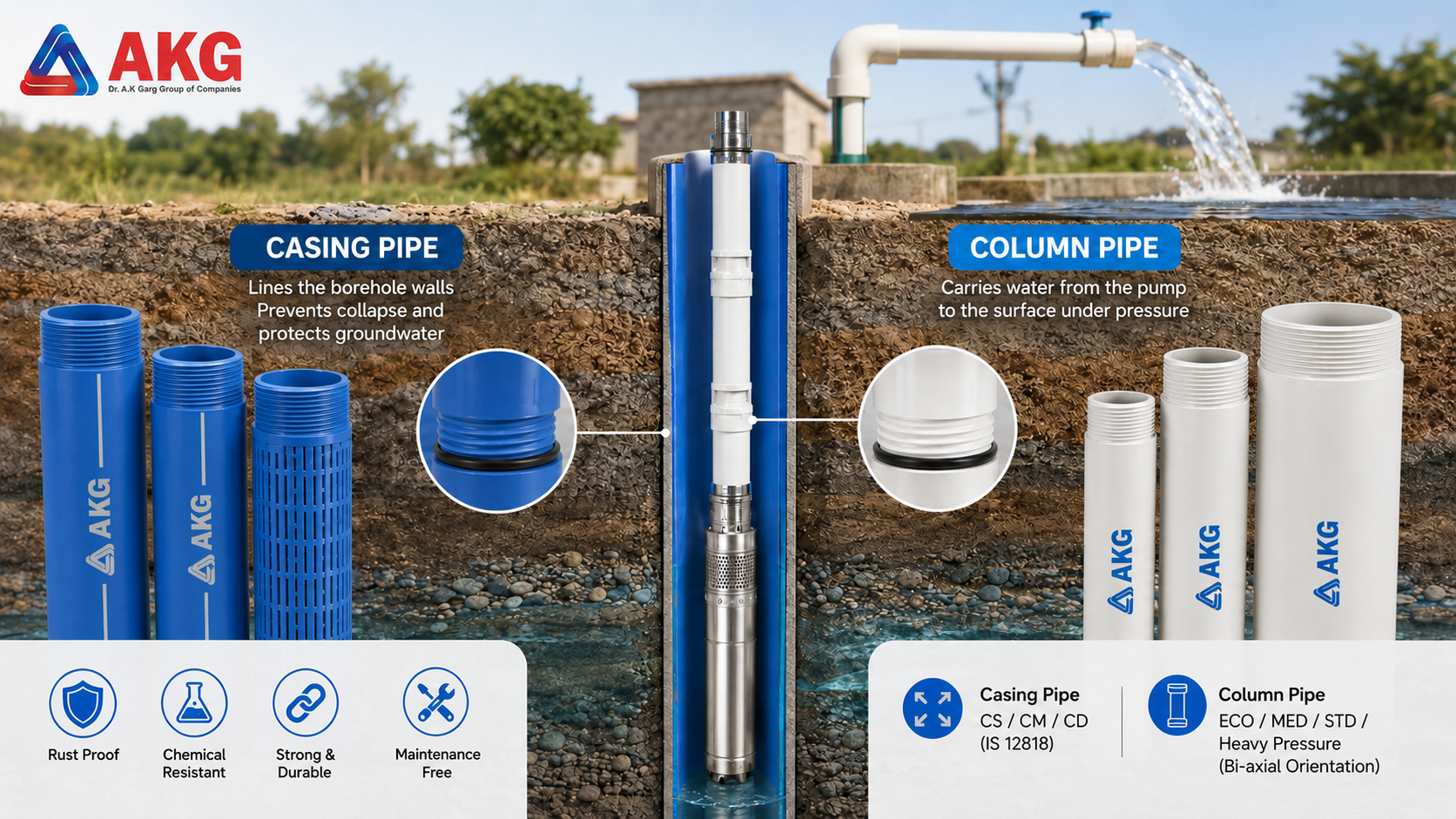
A borewell casing pipe is a structural pipe inserted into a drilled borehole to line its walls, prevent the surrounding soil or rock from collapsing inward, and protect the groundwater inside from surface contamination.
When a borehole is drilled into the ground, the walls of that hole are exposed to surrounding soil, sand, and rock. Without a casing, loose or unstable layers can cave in, blocking the well or damaging equipment. Contaminants like agricultural chemicals, sewage, and surface water can also seep in and pollute the groundwater.
AKG borewell casing pipes are manufactured from high quality uPVC resin conforming to IS 12818 standards. They are available in three classifications based on borewell depth:
- CS (Shallow): For borewells up to 80 metres
- CM (Medium): For borewells up to 250 metres
- CD (Deep): For borewells beyond 250 metres
Both plain and slotted (screen) pipe variants are available. Slotted pipes are placed near water-bearing aquifer zones to allow controlled water entry while keeping sand and soil out. AKG casing pipes are fully rust-proof, chemically resistant, and maintenance-free, which eliminates the corrosion and encrustation problems that affect conventional metal casing materials.
What Is a Borewell Column Pipe and What Does It Do?
A borewell column pipe is the pipe that connects the submersible pump at the bottom of the borewell to the surface outlet. It runs vertically inside the casing, carrying extracted groundwater upward under pressure from the pump to overhead tanks, pipelines, or direct outlets.
Unlike casing pipes, column pipes must handle a different combination of forces: internal water pressure from the pump, the physical weight of the pump and water column hanging below, and the torque and vibration generated by continuous pump operation.
AKG uPVC column pipes are specially designed for submersible pump applications. They are manufactured using a unique bi-axial orientation technique during pipe extrusion, which gives higher drop impact and notch impact strength to the pipes. The joint system uses specially designed square threads with rubber rings that ensure proper gripping, no slipping, and a 100% leak-proof connection. These threads are high-friction threads that do not open even under the constant forward and reverse torque generated by starting and stopping the pump.
AKG column pipes are available across a wide range of sizes and pressure classes including ECO, MED, STD, and Heavy, in nominal diameters from 1 inch to 4 inches, to suit different pump sizes and borewell depths. The expected service life of AKG uPVC column pipes is 25 to 30 years under normal operating conditions.
Key Differences Between Borewell Column Pipe and Casing Pipe
Position and Function in the Borewell
Casing pipe is the outer structural layer of the borewell. It is installed during the drilling process to line and stabilize the borehole itself. It stays in place permanently as part of the borewell's structural foundation.
Column pipe is installed inside the casing after drilling is complete, when the submersible pump is being fitted. It is the working pipe of the system, carrying water from the pump up to the surface. The casing creates the protected environment inside which the column pipe operates.
Material, Diameter, and Joint Construction
Both pipe types are manufactured from uPVC, but they are dimensionally and structurally different. Casing pipes are wider in diameter because they need to accommodate the borehole wall and leave enough internal space for the column pipe and pump to be installed inside them.
Column pipes are narrower and are engineered for internal pressure handling. AKG column pipes feature square thread joints with rubber ring seals and a specially designed thick-and-thin construction where the pipe is made thicker at the threading portion to compensate for material removed during thread cutting. This innovation provides significantly higher strength at the joint without adding unnecessary material weight along the pipe body.
Casing pipes use threaded joints with rubber ring seals designed to maintain structural alignment and resist soil and water pressure from outside the pipe.
Pressure and Load Handling Capacity
Casing pipes are engineered to resist external pressure from surrounding soil and rock, preventing borehole collapse. Their wall thickness and classification are matched to the depth and geological conditions of the installation.
Column pipes are engineered to resist internal water pressure from the pump, as well as the tensile load created by the combined weight of the water column, the pump, and the pipe string hanging vertically below. AKG's special formulation for column pipes ensures the material can handle both internal hydrostatic pressure and huge vertical tensile load simultaneously, which is a unique engineering requirement not shared by casing pipes.
How Both Pipes Work Together in a Complete Borewell System
A complete and properly functioning borewell system needs both types of borewell pipes working in their respective roles.
The casing pipe goes in first. It lines the borehole from the surface down through unstable soil layers, creating a clean, stable, and contamination-free channel. Once the casing is in place and the water-bearing zone is reached, slotted screen pipes allow water from the aquifer to enter the borewell.
The column pipe then goes inside the casing, running from the submersible pump at the bottom all the way to the surface. The pump pushes water up through the column pipe under pressure, delivering it to wherever it is needed.
Remove either component and the system fails. Without the casing, the borehole collapses or becomes contaminated. Without the column pipe, there is no way to bring water from the pump to the surface. Both are essential, and both must be chosen correctly for the depth, load, and geological conditions of the specific site.
Common Mistakes Buyers Make When Choosing Borewell Pipes
Knowing what to avoid helps prevent costly errors down the line:
- Buying casing pipe when column pipe is needed, or vice versa: This is the most common and costly mistake, stemming directly from not understanding the borewell column pipe vs casing pipe difference.
- Selecting the wrong classification for the depth: Using CS pipes for a borewell that requires CM or CD specifications results in structural failure under load.
- Choosing column pipe pressure class below the pump requirement: Using ECO class column pipes with a high-horsepower pump leads to joint failure and pipe disconnection underground.
- Prioritising price over specification: Cheaper pipes that do not match the required depth and load ratings create expensive problems that are difficult and disruptive to fix once the system is installed.
- Ignoring slotted pipe placement: Placing plain casing in aquifer zones instead of slotted screen pipes significantly reduces water yield.
How to Choose the Right Pipe for Your Borewell
Choosing correctly comes down to three questions:
- What is the borewell depth? This determines the casing pipe classification you need: CS for up to 80 metres, CM for up to 250 metres, and CD for deeper borewells. For column pipes, deeper borewells with heavier pump loads require STD or Heavy pressure class pipes.
- What size and horsepower is your submersible pump? The pump size determines the column pipe diameter and pressure class needed to handle the load and water volume without joint failure.
- What are the soil and water conditions at your site? Loose, sandy, or unstable soil requires robust casing. Saline or mineral-rich water requires pipes with strong chemical resistance, which both AKG casing and column pipes provide as uPVC products.
When in doubt, consult a qualified borewell contractor or contact the manufacturer directly to get guidance based on your specific site conditions.
Conclusion
The borewell column pipe vs casing pipe question has a clear answer: they are two entirely different pipes serving two entirely different purposes in the same system. Casing pipe protects and stabilizes the borehole structure. Column pipe delivers water from the pump to the surface. One cannot substitute for the other.
Understanding this difference between column pipe and casing pipe before you purchase ensures you invest in the right products, install them correctly, and get a borewell system that performs reliably for decades.
AKG Group India manufactures a complete range of borewell casing pipe and borewell column pipes engineered specifically for Indian groundwater conditions, available in all depth classifications and pressure ratings to suit every residential, agricultural, and industrial borewell requirement.
FAQ
What is the main difference between a borewell column pipe and a casing pipe?
A casing pipe lines the borehole walls to prevent soil collapse and contamination. A column pipe runs inside the casing and connects the submersible pump to the surface, carrying water upward. Casing provides structural support to the borehole. Column pipe provides the water conveyance pathway. Both are essential but serve completely different functions.
Can I use a casing pipe instead of a column pipe in a borewell?
No. Casing pipes and column pipes are engineered for fundamentally different load conditions. Casing pipes resist external soil pressure. Column pipes resist internal water pressure and the tensile load of the pump weight. Using the wrong pipe type in either role will result in premature failure and system breakdown.
What are the types of borewell pipes available in India?
The main types of borewell pipes are casing pipes and column pipes. Casing pipes are available in CS (Shallow, up to 80 metres), CM (Medium, up to 250 metres), and CD (Deep, beyond 250 metres) classifications as per IS 12818. Column pipes are available in ECO, MED, STD, and Heavy pressure classes in multiple diameters. Both are manufactured in uPVC for corrosion resistance and long service life.
How deep can AKG borewell casing pipes go?
AKG borewell casing pipes are available in three depth classifications. CS pipes are suitable for borewells up to 80 metres. CM pipes are suitable for borewells up to 250 metres. CD pipes are designed for borewells beyond 250 metres. Each classification has a specific wall thickness and pressure rating matched to the soil load and hydrostatic pressure at that depth range.
What makes AKG column pipes suitable for deep borewells?
AKG column pipes are manufactured using a unique bi-axial orientation technique that increases drop impact and notch impact strength. They feature square thread joints with rubber ring seals that resist loosening under the torque and vibration of the submersible pump. A special thick-and-thin pipe construction strengthens the threaded end without adding unnecessary weight. These features make AKG column pipes reliable for deep installations and long-term operation with an expected service life of 25 to 30 years.