PVC Casing Capping Sizes: How to Choose the Right Size for Your Wiring Needs
When it comes to surface wiring, one of the most overlooked decisions is also one of the most important: selecting the correct PVC casing capping size.
Pick a size that is too small and you risk cramming wires together, creating heat buildup and safety hazards. Pick one that is unnecessarily large and you waste money, compromise the finish, and create loose installations that look unprofessional.
The right casing capping dimensions protect your wires, keep your walls neat, and ensure your electrical system performs safely for years. This guide walks you through everything you need to know to make the correct choice for your specific wiring project.
TLDR
- PVC casing capping is measured by its inner width and height in millimetres
- Standard sizes in India range from 16x16mm to 50x16mm
- Size selection depends on wire gauge, number of cables, and type of circuit
- Never fill a casing capping more than 60 to 70 percent of its internal capacity
- Always size up slightly to allow for future wiring additions
- Matching the right size to your load and wire count prevents overheating and damage
Why PVC Casing Capping Size Is a Critical Wiring Decision
PVC casing capping is used for surface wiring in homes, offices, shops, and commercial spaces where cables cannot be concealed inside walls. It serves as a protective channel that keeps wires organised, shielded from physical damage, and safely separated from surfaces.
But casing capping is not one-size-fits-all. The size you choose determines how many wires can be safely accommodated, how much heat can dissipate, and whether the installation meets electrical safety expectations.
An undersized casing capping forces wires to press tightly against each other. This restricts heat dissipation from the insulation, increases the risk of insulation damage over time, and can become a fire hazard in high-load circuits. An oversized one, on the other hand, allows wires to move around loosely, which can damage connections at junction points.
Choosing the right PVC casing capping standard size is therefore not just an aesthetic decision. It is a safety and performance decision.
How PVC Casing Capping Dimensions Are Measured
Casing capping dimensions are expressed as two numbers in millimetres, for example 25x16mm. Here is what each number means:
- The first number refers to the inner width of the casing, which is the horizontal space available to lay wires side by side
- The second number refers to the height of the casing, which is the vertical depth available for wire stacking
So a 25x16mm casing capping has an inner width of 25mm and a height of 16mm. The outer dimensions are slightly larger due to wall thickness, which is typically 1.2mm to 1.5mm depending on the size.
This measurement system helps you calculate the internal cross-sectional area available for your cables and compare it against the total cross-sectional area of the wires you need to house.
Standard PVC Casing Capping Size Chart in India
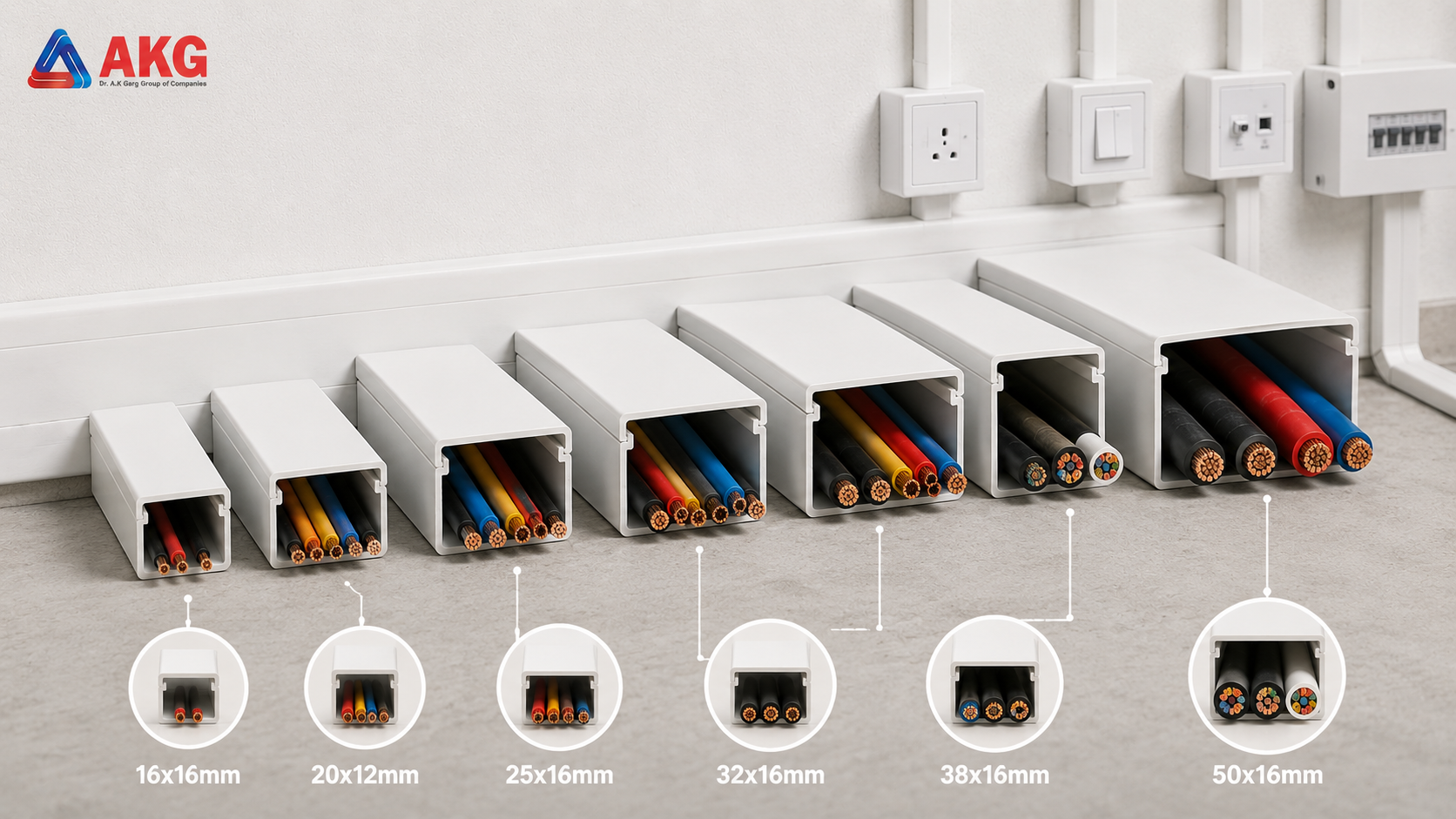
The following sizes are the standard PVC casing capping sizes available in India, as offered by AKG Group India:
| Size (mm) | Inner Width | Outer Width | Height | Wall Thickness |
|---|---|---|---|---|
| 16x16 | 16mm | — | 16mm | 1.2mm |
| 20x12 | 12mm | 20mm | 12mm | 1.2mm |
| 25x16 | 20mm | 25mm | 12mm | 1.2mm |
| 32x16 | 25mm | 32mm | 32mm | 1.2mm |
| 38x16 | 36mm | 38mm | 38mm | 1.3mm |
| 50x16 | 48mm | 50mm | 50mm | 1.5mm |
These six sizes cover the full range of residential, commercial, and light industrial surface wiring requirements. Smaller sizes like 16x16mm and 20x12mm are used for single-circuit light wiring. Larger sizes like 38x16mm and 50x16mm are used for multi-circuit runs or data and power cable management in offices and commercial spaces.
Factors That Decide the Right PVC Casing Capping Size
Wire Gauge and Number of Cables
The most direct factor in size selection is how many wires you need to run and what gauge they are. Thicker wires take up more space. Multiple wires running through the same casing require a wider channel.
A general rule is to never fill more than 60 to 70 percent of the internal cross-sectional area of the casing. This leaves adequate space for heat dissipation and prevents insulation damage from wire-to-wire contact under load.
For a single 1.5 sq mm wire used in lighting circuits, a 16x16mm or 20x12mm casing is typically sufficient. For two to three wires of 2.5 sq mm used in power points, a 25x16mm or 32x16mm casing is more appropriate. For heavier runs involving multiple thick wires or mixed circuits, 38x16mm or 50x16mm should be considered.
Type of Circuit and Load
Different circuits carry different loads and generate different levels of heat in the insulation under continuous use. High-load circuits like air conditioner wiring, geyser points, or distribution runs require more internal space to keep operating temperatures within safe limits.
Low-load circuits like lighting or bell circuits can be safely managed with smaller casing sizes. Always match the casing capacity to the expected sustained load of the circuit, not just the number of wires.
Future Expansion Buffer
A very common and costly mistake in wiring projects is sizing the casing capping exactly for current needs with no room for future additions. Electrical requirements in homes and offices tend to grow over time as more appliances, devices, and circuits are added.
Sizing up by one step during installation costs very little at the time but saves significant money and disruption later. If your current requirement fits a 20x12mm casing, installing a 25x16mm gives you meaningful expansion capacity without any visible difference in the finish.
Matching Wire Gauge to PVC Casing Capping Standard Size
Here is a practical reference to help match wire gauge and quantity to the appropriate PVC casing capping standard size:
| Application | Wire Size | Wires | Recommended Casing Size |
|---|---|---|---|
| Lighting circuit | 1.5 sq mm | 1 to 2 | 16x16mm or 20x12mm |
| Power points | 2.5 sq mm | 2 to 3 | 25x16mm or 32x16mm |
| AC or geyser point | 4 sq mm | 2 | 32x16mm or 38x16mm |
| Multi-circuit run | Mixed | 4 or more | 38x16mm or 50x16mm |
| Office cable management | Mixed data and power | Multiple | 50x16mm |
These are general guidance values. Always verify against the actual wire diameter and count for your specific installation.
Common Sizing Mistakes That Cost You Later
Knowing the right size is only half the picture. Knowing what to avoid is equally important:
- Overfilling the casing: Running more wires than the cross-section safely allows creates heat buildup and accelerates insulation wear. This is the most common and most dangerous sizing mistake.
- Using a smaller size to save cost: A smaller casing costs slightly less per metre but creates long-term risk. The cost of rewiring or replacing damaged insulation far exceeds the savings from undersizing.
- Ignoring wall thickness in calculations: Some installers calculate only outer dimensions when sizing. Always use inner dimensions to determine actual wire capacity.
- Not accounting for wire bunching at bends: At corners and direction changes, wires naturally bunch together. Sizing with no buffer makes these points tight and prone to insulation damage.
- Skipping the expansion buffer: As discussed, sizing exactly for today's needs without any headroom is a decision that almost always becomes a problem within a few years.
Quick Checklist to Pick the Right Casing Capping Size
Before finalising your casing capping size, run through this checklist:
- Count the total number of wires you need to route through the casing
- Note the cross-sectional area of each wire in sq mm
- Calculate the total wire area and ensure it does not exceed 60 to 70 percent of the casing's inner cross-section
- Identify the load type: lighting, power point, heavy load, or multi-circuit
- Add one size of buffer for future expansion
- Confirm the size is available in the standard lengths required for your run
- Match the casing colour to your wall finish for a professional result
Conclusion
Getting PVC casing capping sizes right is one of the simplest ways to ensure a safe, professional, and future-ready surface wiring installation. The standard range of sizes from 16x16mm to 50x16mm covers every residential and commercial wiring requirement when selected correctly.
The key is to base your selection on inner dimensions, actual wire count and gauge, circuit load, and a sensible expansion buffer. Never size down to save cost and never overload a casing beyond its safe capacity.
AKG Group India's PVC casing capping and trunking range is manufactured from unplasticised high impact strength polyvinyl chloride, available in all standard sizes, and designed to deliver high impact strength, dimensional stability, and a clean finish for wiring systems in homes, offices, and commercial spaces.
FAQ
What is the most common PVC casing capping size for home wiring?
The most commonly used sizes for home wiring in India are 20x12mm and 25x16mm. The 20x12mm size suits single-wire lighting circuits, while 25x16mm is appropriate for power point wiring with two to three cables of 2.5 sq mm. For heavier circuits like AC or geyser points, 32x16mm is recommended.
What does 25x16 mean in PVC casing capping?
In PVC casing capping, 25x16 refers to the outer width of 25mm and the height of 16mm of the casing channel. The inner usable width is slightly smaller at approximately 20mm after accounting for wall thickness. This size is suitable for light to medium-duty wiring with two to three cables running together.
How many wires can fit inside a 32x16 mm casing capping?
A 32x16mm casing capping has an inner usable width of 25mm and a height of 32mm. As a general rule, wires should not occupy more than 60 to 70 percent of the internal cross-sectional area. This size comfortably accommodates three to four wires of 2.5 sq mm, or two wires of 4 sq mm, depending on insulation thickness and wire arrangement.
What is the standard length of PVC casing capping in India?
PVC casing capping is typically sold and installed in standard metre lengths. Smaller sizes like 16x16mm and 20x12mm are packed in 400-metre quantities per standard packaging. Larger sizes like 38x16mm and 50x16mm are available in 100-metre packs. Individual pieces at the installation site are cut to the required length using a standard saw or cutter.
Can I use a smaller PVC casing capping size to save cost?
This is not advisable. Undersizing a casing capping to reduce cost is one of the most common wiring mistakes. Overfilled casings restrict heat dissipation, accelerate insulation wear, and can become a fire risk in high-load circuits. The cost difference between adjacent sizes is minimal, while the long-term cost of insulation damage, rewiring, or fire-related repairs is significantly higher. Always size correctly or one step up.